Wednesday, 29 April 2015

G.I., Dep. of Pers. & Trg., O.M.No.I-11020/1/2014-Estt.(AL), dated 28.4.2015

Establishment (Allowance) Section

SI.No. Question Answer

Children Education Allowance

1. Whether reimbursement of Children Education Allowance is admissible for the:
(a) Nursery/LKG/UKG as there is no provision of recognition of these classes in most of the States/UTs;
Reimbursement is permissible only if the child is studying in a recognised educational institution.


(b) Third child if either of the first two children is disabled to the extent that he/she cannot go to school;
Reimbursement is allowed to only the two eldest surviving children of the Government servant except when the 2nd child birth results in multiple births or the 3`d child is born due to failure of sterilization operation.

(c) The children borne out of second marriage or the children of second wife/husband in additions to children from first marriage;
Reimbursement is allowed to only the two eldest surviving children of the Government servant.

(d)  Entitlement of number of Note Books.
Reimbursement is permissible for any number of note books as may be prescribed by the recognised educational institution.

OTA/NDA

2. The reasons for not enhancing rates of OTA/NDA
The 5th and the 6th Central pay Commission did not recommend enhancement of rates of OTA/NDA.

Honorarium/Fee

3.  Whether honorarium is payable to the Chairperson/Members of the DPC and also such other Departmental Committees, viz., Committee on Sexual Harassments at work place, etc.?
In terms of the provisions of FR 46 (b), the Central Government may grant or permit a Government servant to receive an honorarium as remuneration for work performed which is occasional or intermittent in character and either so laborious or of such special merit as to justify a special reward. Except when special reasons, which should be  recorded in writing, exist for a departure from this provision, sanction to the grant or acceptance of an honorarium should not be given unless the work has been undertaken with the prior consent of the Central Government and its account has been settled in advance.

Guidelines for payment of Honorarium under FR 46 (b) have already been laid down inter alia vide this Department’s OM No.17011/9/85- Estt. (AL), dated 23.12.1985 and OM No. 17020/1/91- Estt. (AL), dated 18.11 .1991. It has also been clarified that no honorarium should be granted for temporary increases in work.

4. Whether retention of “Fee” for delivering lectures in Government/private bodies is permissible? As per para 6 of DoP&T’s O.M.No. I 6013/1/79-Estt.(AL) dated 11th February, 1980, payments received by Government servants as income from books, articles, papers and lectures on literary, cultural, artistic, technological and scientific subjects including management sciences; will not be subject to crediting one-third of the amount to the general revenues.

Establishment (Leave) Section:

5. Whether male Government servant, who is single parent, can be allowed Child Care Leave? No. CCL can be granted to female employees only.

6.  Whether Bond on Study Leave can be transferred from Central Government to State Government?
No. Bond executed by the Government servant while proceeding on study leave cannot be transferred on his/her appointment in State Government/PSU/Autonomous bodies.

7.  What is the limit of leave encashment while availing LTC by dependents or spouse within the same block year?
The Government Servants governed by the CSS (Leave) Rules, 1972 and entitled to avail LTC may en-cash earned leave up to 10 days at the time of availing both types of LTCs., i.e., `Hometown’ and `Anywhere in India’. However, when the one and the same LTC is being availed of by the Government Servant and his family members separately in a block year, encashment of leave would be restricted to one occasion only.

Friday, 24 April 2015

LTC CLARIFICATION

G.I., Dept. of Pers. & Trg., O.M.F.No.31011/1/2013-Estt (A.IV), dated 21.04.2015

Subject:- Leave Travel Concession (LTC) entitlements of unmarried Government servants – Conversion of Home Town LTC facility into travel to different parts of the country permissible under the special dispensation scheme – Clarification — regarding.

In relaxation to the Central Civil Services (Leave Travel Concession) Rules, 1988, special dispensation is allowed to the Government servants from time to time. Presently, one such dispensation in operation is the relaxation to the Government servants to travel by air to visit North-East Region or to Jammu & Kashmir or to the Andaman & Nicobar Islands by converting one block of Home Town LTC available to them.

2. Vide this Department’s Office Memorandum No. 31011/17/85-Estt.(A) dated 03.04.1986, unmarried Central Government employees, who have left their wholly dependent parents/sisters/minor brothers at their home town are allowed the benefit of LTC to visit their home town every year. This concession is in lieu of all other LTC facilities admissible to the Government servant himself and to his/her parents/sisters/minor brothers.

3. This Department is in receipt of references seeking clarification on the admissibility of conversion of Home Town LTC facility into travel to different parts of the country, which is permissible under special dispensation, to such unmarried Government servants.

4. The matter has been examined in consultation with Ministry of Finance. It has been decided that the facility of conversion of Home Town LTC to allow travel to different parts of the country, under the special dispensation scheme, will also apply to an unmarried Central Government servant, who is eligible to avail the benefit of LTC to visit Home Town every year. This facility may be availed by converting one occasion of Home Town LTC out of the four Home Town LTC occasions available in a block of four years.

Thursday, 23 April 2015

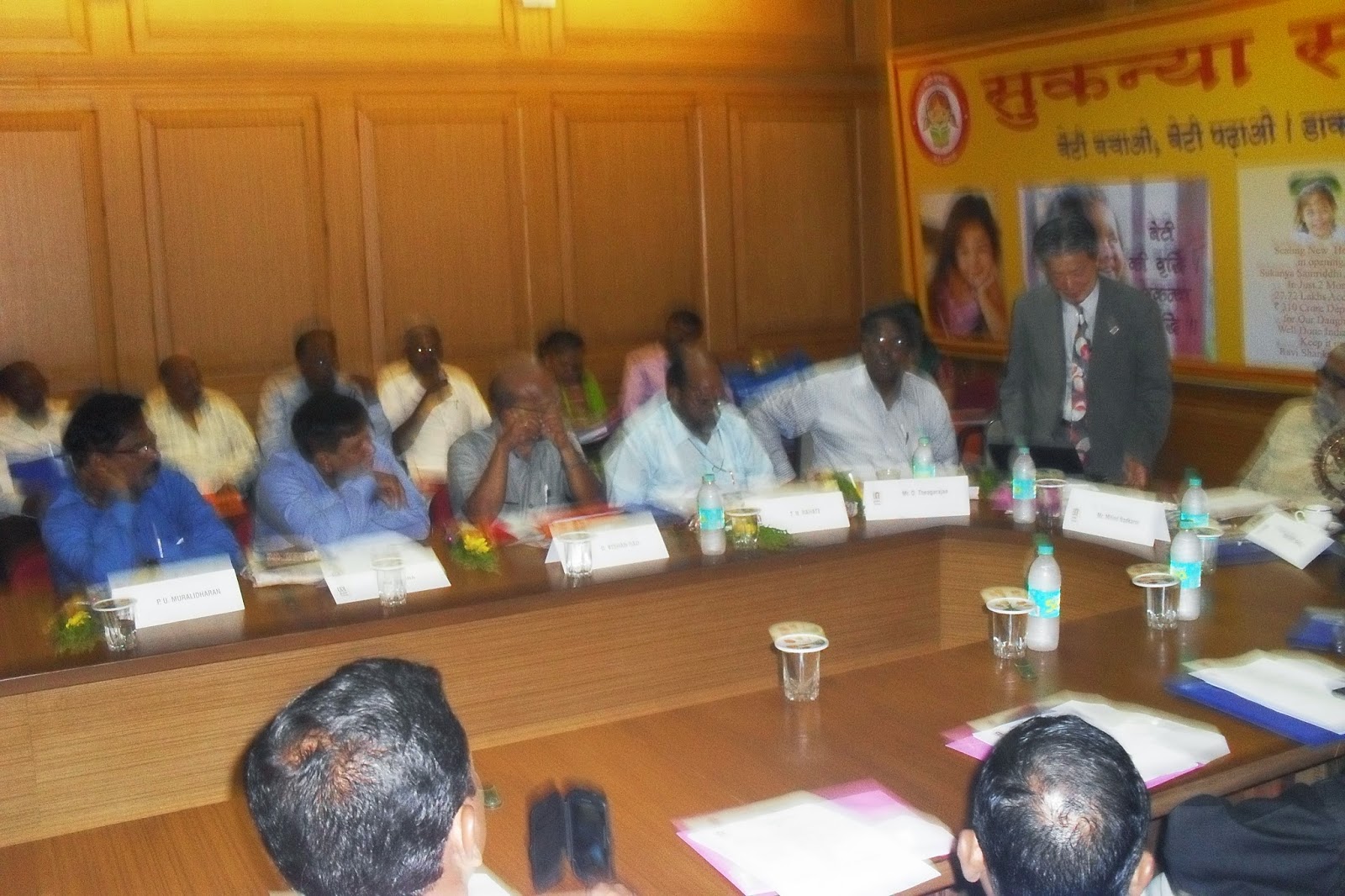
FNPO-JPGU Seminar was held in Mumbai on 19/04/2015.  On the subject of Challenges before India Post  was inaugurated by the Brother Eichi Ito Director UNI APRO (POSTAL). Seminar was presided by Brother Milind Nadkarni President UNI ILC .SGFNPO welcomed the gathering and also thanks the JPGU & Brother Eichi Ito for their support to FNPO colleagues. Brother Takumi Shoji explanied about present status of Japan Post& its employees,   Shri TN.Rahate President FNPO& FNPO affiliated unions General secretaries  S/Shri D.Kishan Rao, N.Ramappa,O.P.Khanna,K.Sivadasan & PU.Murlidharan addressed the seminar. Circle Secretaries of FNPO affiliated unions & Office bearers participated in the seminar.  Sisters Anjali& Sunetra coordinated seminar.

Wednesday, 22 April 2015

SEMINAR AT BOMBAY WITH UNI-APRO AND JAPAN POST DELEGATES


General Provident Fund Interest Rate  8.7% for 2015-16

Government Decides to Fix Interest Rates at 8.7% for General Provident Fund(GPF) and other Similar Funds Including Special Deposit Scheme, 1975(SDS,1975) for Non-Government Provident, Superannuation and Gratuity Funds for the Financial Year 2015-16.


It was decided by the Government to link the interest rates of State PFs (General Provident Fund and other similar funds) including Special Deposit Scheme, 1975 (SDS, 1975) for Non-Government Provident, Superannuation and Gratuity Funds for the FY 2015-16 to Public Provident Fund (PPF) rates. In pursuance of that decision, the Government has decided to fix the rates 8.7% per annum applicable to the following:-

· The General Provident Fund (Central Services).
· The Contributory Provident Fund (India).
· The All India Service Provident Fund.
· The State Railway Provident Fund.
· The General Provident Fund (Defence Services).
· The Indian Ordnance Provident Fund.
· The Indian Ordnance Factories Workmen’s Provident Fund.
· The Indian Naval Dockyard Workmen’s Provident Fund.
· The Defence Services Officers Provident Fund.
· The Armed Forces Personnel Provident Fund.

The rate of interest is applicable to the above funds w.e.f. 1st April, 2015 and until further orders.

Recently, the Government had kept the interest rates for PPF and other Small Savings Schemes intact. However, interest rates for 5 year Senior citizen Saving Scheme and Sukanya Samriddhi Account Scheme have been increased from 9.2 to 9.3% and 9.1 to 9.2% respectively, keeping in view the commitment of the Government towards the welfare of the girl child and the senior citizens.

Sunday, 12 April 2015

Attention to Divisional / Circle Secretaries.
I am receiving calls from various Divisions/ Circles about the Verification of Membership.
Federation has already clarified that Verification of membership and enrolment of new members and inclusion of other union are two different process.
Verification of membership is contacted once in five years.
Inclusion of new members and other union members is being done every year for which 30th April of each year is last date.
Now the Directorate has extended the period of Verification process by one month. Therefore  I request all Divisional secretaries to submit forms  from the new members as well as other members on30/04/2015,
In regard to verification process new form will be supplied by the Directorate in the   month of May 2015 . New form will be posted in our website as and when received from the Directorate. 
In that new form, we have to obtain signatures of  all members this is for your information once again I appeal  to you all please submit declarations on30/04/2015 in respect of new members and other union members.

Thursday, 9 April 2015

G.I., Dept. of Pers. & Trg., O.M.F.No.31011/3/2015-Estt (A-IV), dated 01.04.2015

Subject:- LTC Claims – Need for observing prescribed procedures

This Department receives a large number of recommendations for relaxation of some or the other provision of the Central Civil Services (Leave Travel Concession) Rules, 1988, (hereinafter referred to as LTC Rules), in individual cases. It is seen that, in most cases the situation arises are due care had not been exercised by the Government servant and/or the administrative authority in claiming LTC or in examination.


2.The references mainly relate to:
a) Late submission of claims;

b) Booking of air tickets through an agency not authorized by the Government for this purpose;
c)Travel by private vehicles; and
d)Claims for wrong block of years.
3.In this connection it may please be noted that the primary responsibility for ensuring compliance with the rules is that of the Government servant. The of-repeated plea of ignorance of rules cannot be a valid ground for relaxation of rules. At the same time it has also been noticed that the administrative authorities have also shown laxity and due diligence on their part could have prevented such situations from arising.

4.Late Submission of Claim

4.1 In terms of Rules 14 and 15(vi) of LTC Rules, the time limit for submission of LTC claim is :

i) Within three months of completion of return journey, if no advance is drawn;
ii) Within one month of completion of return journey, if advance is drawn.

Powers have been delegated, as under, to the Ministries/Departments to relax these limits with the concurrence of the Financial Advisor.

a) Upto 6 months, if no advance is drawn;
b) Upto 3 months if advance is drawn, provided the Government servant refunds the entire amount of advance (not merely the unutilized portion) within 45 days of completion of return journey.

4.2 As per Rule 12(a) of the “Compendium of Rules on Advances to Government Servants”, it is the responsibility of the Head of Office to effect recovery of advances and also to see that the conditions attached to each advance are fulfilled. The Drawing and Disbursing Officer (DDO) is required to keep a watch on the advances and furnish monthly statements to the AP&AO. In addition, the DDO is also required to adjust all outstanding short term advances at the close of financial year.

5.Booking of air tickets through agents other than Government approved agents

5.1 Government servants travelling by air under LTC are required to book their tickets either directly from the airline or through the approved agencies viz: M/s Balmer Lawrie & Co. Ltd/ M/s Ashok Tours & Travels Ltd/IRCTC. Booking through any other agency is not permissible.

6. Travel by private vehicles.

6.1 As per LTC rules, a Government servant may travel only by vehicles operated by Central/State Government or local bodies or by any corporation in the public sector owned/controlled by Central/State Government. Journey on LTC by taxi, auto-rickshaw etc, are permissible only between places not connected by rail. This is further subject to the condition that these modes operate on a regular basis from point to point with the specific approval of the State Governments/transport authorities concerned and are authorized to ply as public carriers.

7. Claims for wrong block of years

7.1 Whenever a Government servant applies for LTC advance, the administrative authority is required to verify from the service book and certify the entitlement of the Government servant. Cases of the type mentioned in para 2(d) would not arise, if this is properly done.

8. LTC Rules also provide that a government servant who has been granted LTC Advance is required to submit copies of the tickets within 10 days of drawal of advance. The administrative authority can at this stage itself check the date of commencement of journey; whether ticket has been booked direct from airline or through approved agency etc. Any discrepancy can be brought to the notice of the government servant so that he can take remedial action, if needed.

9. Even in cases where advance is not drawn, the Government servant is required to give prior intimation of his intention to avail LTC. The administrative authority can check the details indicated especially w.r.t entitlement. A watch can also be kept to ensure timely submission of claims.

10. All Ministries/Departments are requested to bring the contents to this O.M. to the notice of all concerned. It may also be noted that requests for relaxation of rules shall be considered by this Department only if it is established that the deviation is due to reasons beyond the control of the Government servant and there has been no laxity on the part of the administrative authorities concerned.